
Clinician Intro Guide
Video Self-Modeling for Selective Mutism: Intro Guide for Clinicians
Video self-modeling can be one of the fastest ways to make a feared speaking moment feel less novel to a child with selective mutism. This guide is a clinician-facing overview of how the mechanism works, where it fits in treatment, and how to use it without turning it into a performance task.
If you want the broader clinician workflow around assessment and planning, pair this with our intro to selective mutism for clinicians. This page stays focused on VSM specifically.
What Is Video Self-Modeling?
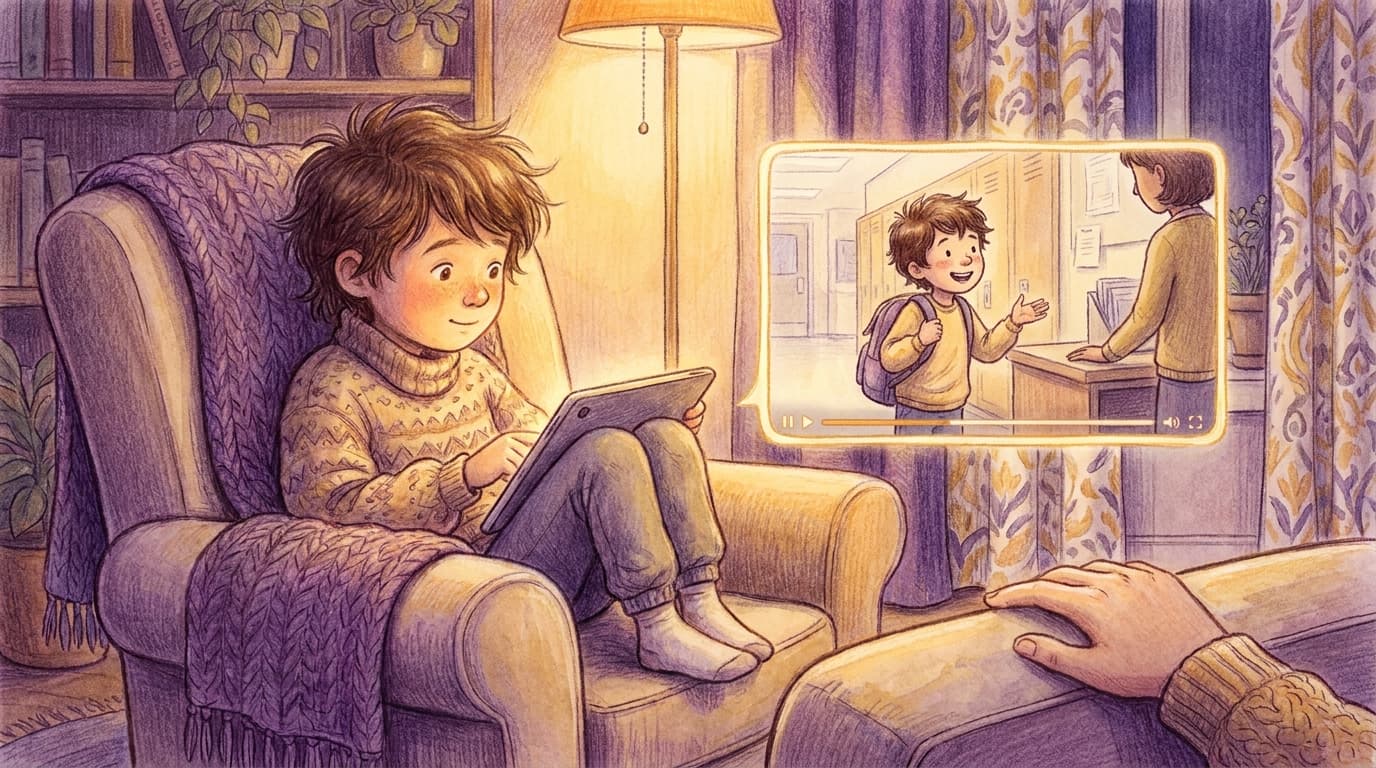
Video self-modeling, or VSM, is a technique where a child watches a short video of themselves or a similar peer successfully performing a target behavior, in this case speaking in a challenging situation. Repeated viewing before the live attempt reduces anticipatory anxiety and primes the brain for successful performance. It is used for selective mutism, stuttering, autism, and other communication-related anxiety conditions.
Clinicians use it to make the first live attempt feel less like a cold start. The point is not to make a child memorize lines. The point is to make the situation feel familiar, survivable, and already partially accomplished.
How It Works: The Mechanism in Plain English
The most useful way to understand VSM is through the anxiety-avoidance loop. A child feels anxiety, avoids speaking, experiences immediate relief, and then the brain learns: “Good, avoiding kept me safe.” The next time the situation appears, anxiety spikes even faster.
Video self-modeling interrupts that loop by creating a safe preview of success before the live attempt. The child sees the situation, hears the words, and watches a successful outcome while sitting in a low-pressure setting, not standing at the classroom door or restaurant counter. That changes what the nervous system expects.
The practical takeaway is not a statistic. It is this: when VSM is paired with real-world exposure, many children approach the live task with less novelty, less anticipatory dread, and better odds of getting through the first rung successfully.
Want to see the product version of this workflow? Start with BVJ Desktop for Clinicians.
Self-Modeling vs. Peer Modeling vs. Professional Video Models
Self-Modeling
The child is the star of their own video. This is often the strongest format because identification is total: the child is not being asked to imagine success, they are watching themselves do it.
The tradeoff is that it requires you to capture successful footage first, which can be difficult early in treatment.
Peer Modeling
A similar-aged peer performs the target behavior. This works well when you do not yet have footage of the child succeeding or when self-recognition itself is still too activating.
Many children respond almost as well to a relatable peer as to themselves when the peer feels close enough.
Professional Video Models
These are pre-built videos featuring actors or scenario performers showing realistic speaking moments. They remove the filming burden and make it easier to get repetitions quickly.
In practice, many clinicians use professional videos to establish momentum and then layer in self-modeling later.
How to Use VSM Clinically
Step 1: Pick a target that is just above baseline.
Use the child's exposure ladder to choose a rung that is difficult but still reachable. If the target is too far ahead of baseline, the video becomes disconnected from the child's felt reality.
Step 2: Keep recording conditions low-pressure.
Whether you are filming a self-model clip or using the child's voice with a prepared scenario, the recording context should not feel evaluative. Calm, brief capture almost always works better than trying to coach a performance.
Step 3: Use repeat viewing before the live attempt.
Three to five viewings across a few days is a common starting point. The goal is to reduce novelty and create a success memory before the feared speaking moment happens in real life.
Step 4: Treat the live attempt as the next rung, not the final exam.
The real-world exposure should stay close enough to the video that the child can feel the continuity. The more the live moment resembles the viewed moment, the more useful the bridge becomes.
Why Repeat Viewing Matters
Every viewing is a low-stakes exposure. The child is encountering the feared cue — the teacher, the counter, the group response, the greeting — without the immediate demand to perform. Anxiety weakens when the brain repeatedly meets the cue without catastrophe.
The video acts like a beta test for the live event. By the time the real attempt happens, the child's nervous system has already had multiple low-threat rehearsals of success.
Where Brave Voice Journey Fits
Brave Voice Journey shortens the setup burden that usually keeps clinicians from using VSM consistently. Instead of filming every scenario from scratch, you can start with a library of realistic speaking moments and align them to the child's current rung.
The clinician selects the scenario, captures the child's response in-session or coordinates with home practice, and uses repeat viewing as a bridge into the next live attempt. It keeps the rationale clinician-led while making the workflow much lighter operationally.
Explore the clinician workflow at BVJ Desktop for Clinicians.
Frequently Asked Questions
Does video self-modeling actually work for selective mutism?
Yes. VSM has a meaningful research base as an adjunctive intervention for selective mutism and anxiety-based communication avoidance. It works best when paired with exposure targets, careful pacing, and real-world generalization rather than being used as a standalone fix.
At what age is VSM useful in selective mutism treatment?
Many children as young as preschool age can respond to video models, especially when the clips are short and concrete. Self-modeling tends to become more powerful once the child has strong self-recognition, but older children, teens, and even young adults can benefit from the same mechanism.
How often should a clinician ask a child to watch the video?
A common starting point is three to five viewings over a few days before the live attempt, then periodic rewatching while the target is active. The point is not overexposure; it is to build familiarity and reduce the novelty of the feared speaking moment.
Ready to bring VSM into sessions?
Keep the ladder small, the video short, and the live attempt close enough to feel possible.
Explore the clinician version →